

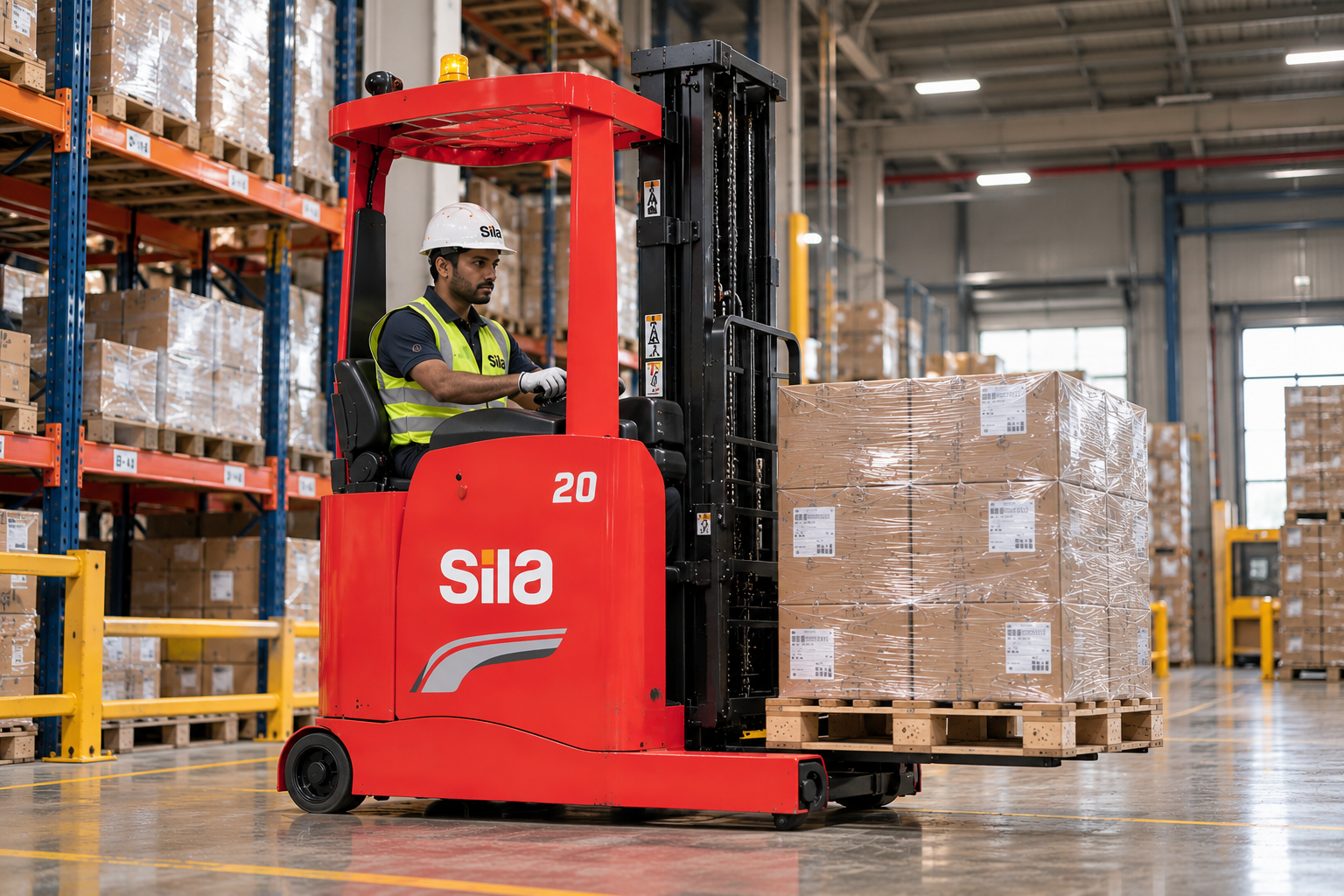
In any warehouse or plant, the pace of work is set by the machines that move goods. When a forklift breaks down at the dock or a reach truck sits idle for want of an operator, vehicles queue, lines slow and costs rise.
Material handling equipment (MHE) is the machinery used to lift, move, stack and store goods inside warehouses, factories and distribution centres. Common examples include forklifts, reach trucks, pallet trucks and very narrow aisle (VNA) trucks. MHE matters because it sets how much a site can move in a day, how densely it can store, how safely people work alongside machines, and what each pallet movement costs.
In this blog, we look at the main types of MHE, how to choose the right equipment, the shift to electric and lithium-ion, rental vs purchase, and how SILA supports material handling operations across India.
Why Material Handling Equipment Matters
The right MHE fleet affects four things every operations head tracks:
- Throughput: how many pallets are received, stored and dispatched each shift.
- Storage density: trucks that work in narrower aisles or lift higher create more pallet positions in the same building.
- Safety: trucks and pedestrians share the floor, so equipment design and operator skill drive incident risk.
- Cost: energy, maintenance, wages and downtime add up to a cost per operating hour.
Common Types of Material Handling Equipment
Most warehouses and plants use a mix of these five equipment types.
Equipment | What it does | Best suited for |
Counterbalance electric forklift | Carries loads at the front, balanced by a rear counterweight; drives straight up to docks and stacks | Docks, production floors, yards |
Reach truck | Extends forks forward over support legs to lift higher in narrower aisles | Indoor racked warehouses |
Battery-operated pallet truck (BOPT) | Low-lift truck for horizontal pallet moves over short distances | Docks, staging, line-side |
Very narrow aisle (VNA) truck | Works in the narrowest aisles for maximum pallet positions; articulated models can also load vehicles | High-density racked storage |
Industry-specific equipment | Order pickers, cold-storage trucks and attachments such as bale clamps, carton clamps, rotators and tyre handlers | Textiles, FMCG, tyres, cold chain, e-commerce |
Broader definitions of MHE also include racking, conveyors and automated systems, but industrial trucks are the equipment most businesses buy, rent and staff day to day.
How to Choose the Right Material Handling Equipment
Start with the job, not the model. Before shortlisting equipment, answer these questions:
- What are you moving? Pallets, rolls, bales, cartons or tyres, and between which points.
- How heavy is the load? Include the load centre and attachment weight; rated capacity falls as lift height rises.
- How wide are your aisles and how high are your racks? These decide whether you need a forklift, reach truck or VNA truck.
- Where will it operate? Indoors or outdoors, in cold storage, on ramps or under hygiene rules.
- How many shifts do you run? This drives battery choice and fleet size.
- Who will service and operate it? Check technician response times, local spares and operator availability.
Electric and Lithium-Ion Forklifts: Why the Shift Is Happening
Electric forklifts produce no exhaust where they operate, run more quietly and need less routine servicing than diesel trucks. That makes them the default for indoor, food and pharma sites. Diesel refuels faster and costs less upfront, but its exhaust limits indoor use.
Within electric, lithium-ion batteries are replacing lead-acid on multi-shift sites. A lithium-ion pack is sealed, needs no watering and can be topped up during breaks, so there are no battery swaps.
Feature | Lithium-ion | Lead-acid |
Full charge time | 1.5–2 hours | 8–10 hours |
Battery swap for multi-shift work | Not required | Required |
Battery maintenance | None | Regular |
Cycle life (charge cycles) | 2,000–3,000 | 700–1,500 |
Figures from SILA’s MHE profile; actual values vary by battery and duty cycle. The trade-off is a higher upfront battery cost, which a rental model shifts to the provider.
SILA’s rental fleet is 100% electric, with more than 60% on lithium-ion. According to SILA, switching from diesel to lithium-ion can cut operating cost per hour by up to 70% and save 30–45 tonnes of CO₂ per forklift per year.
MHE Rental vs Purchase: Which Makes More Sense?
Buying MHE is capital expenditure: you pay upfront, own the asset and manage its maintenance. Renting is operating expenditure: a monthly fee, with the provider owning and maintaining the equipment.
Consideration | Purchase (CapEx) | Rental (OpEx) |
Upfront cash | Full equipment cost | None or minimal |
Maintenance | Separate cost and effort | Usually included |
Fleet size | Fixed | Can scale with demand |
Best fit | Stable, high-utilisation sites with in-house maintenance | Growing, seasonal or multi-site operations |
Buying can cost less over a long asset life when utilisation is high and stable. Accounting treatment depends on the contract, including under Ind AS 116, so involve your finance team early.
What Keeps an MHE Fleet Running
Uptime depends as much on how trucks are maintained and driven as on which trucks you choose.
- Preventive maintenance: service on operating hours, not breakdowns, with daily pre-shift checks.
- Service and spares: downtime is set by how fast a technician arrives and whether the part is nearby.
- Trained operators: operator skill affects safety, rack damage and battery life.
- Fleet technology: telematics shows each truck’s location, usage and faults, so idle trucks and early problems are visible.
How SILA Supports Material Handling Operations
SILA’s MHE business, part of SILA Solutions, brings equipment, service, manpower and technology together under one rental relationship. SILA reports 500+ machines deployed and contracted for 45+ industrial clients across 41 locations in 14 states.
Equipment
Hangcha forklifts from 2/2.5 to 15 tonnes, reach trucks of 1.6 and 2 tonnes lifting up to 15 m, and lithium-ion BOPTs, plus Aisle Master articulated VNA trucks and industry-specific attachments such as bale clamps and carton clamps.
Service
An exclusive equipment and service partnership with Nilkamal Material Handling, the master franchise for Hangcha in India, provides a pan-India service and spares network, preventive maintenance and equipment health monitoring.
Manpower
1,000+ SILA-trained MHE operators run about 70% of the fleet. Project Unnati, SILA’s operator career pathway, develops material handlers into certified operators, shift leads and fleet supervisors.
Technology
SILA Connect, SILA’s proprietary platform, provides live machine data, utilisation and cost dashboards, and digital compliance records. Listed safety features include AI camera pedestrian detection, seatbelt interlocks and biometric access.
Rental model
One monthly rental on 36-month terms, with no capital outlay and maintenance included.
Clients have grown with SILA across plants: Sanathan Textiles runs 56+ machines across 2 plants, Simpolo Tiles & Bathware 40+ across 3, and Craftsman Automation 20+ across 6. Learn more about SILA’s material handling solutions.
Who Should Consider MHE Rental?
- Manufacturers adding capacity or opening new plants
- Warehouses and logistics operators handling seasonal peaks
- Companies moving from diesel to electric forklifts
- Multi-site businesses that want one partner for equipment, service and operators
Conclusion
Material handling equipment decisions shape throughput, safety and cost for years. The right choice starts with the application, weighs electric and lithium-ion options, and treats maintenance, operators and technology as part of the fleet rather than extras.
Planning a new site or reviewing your current fleet? Email MHESolutions@silagroup.co.in, call +91 91677 31517, or contact SILA.
FAQs
What is the difference between a forklift and a reach truck?
A counterbalance forklift balances its load with a rear counterweight and works at docks, in yards and on production floors. A reach truck extends its forks forward over support legs, so it lifts higher and works in narrower aisles, mainly indoors.
What is a VNA forklift?
A very narrow aisle (VNA) forklift works in aisles much narrower than a reach truck needs, so a warehouse fits more pallet positions in the same floor area. Articulated VNA trucks can also load vehicles and work outside the racking.
What are the benefits of lithium-ion forklifts?
Lithium-ion forklifts charge in 1.5–2 hours rather than 8–10, need no watering or battery swaps, and can be topped up during breaks. They cost more upfront, so the case rests on lifecycle cost and utilisation.
Is forklift rental better than buying?
Rental suits operations that want no upfront outlay, predictable costs, included maintenance and the ability to scale. Buying can cost less over a long asset life at high, stable utilisation with in-house maintenance.
What does SILA's MHE rental include?
According to SILA’s MHE profile, its rental combines electric equipment, trained operators, preventive maintenance through its Nilkamal service partnership, and fleet visibility through SILA Connect, for a single monthly rental.